What Is Lumora Shader?
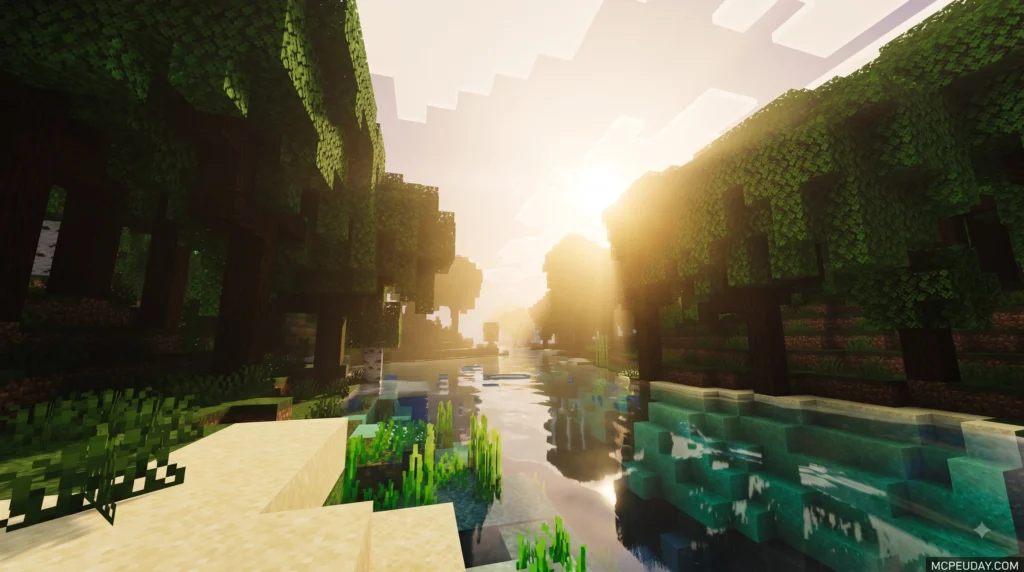
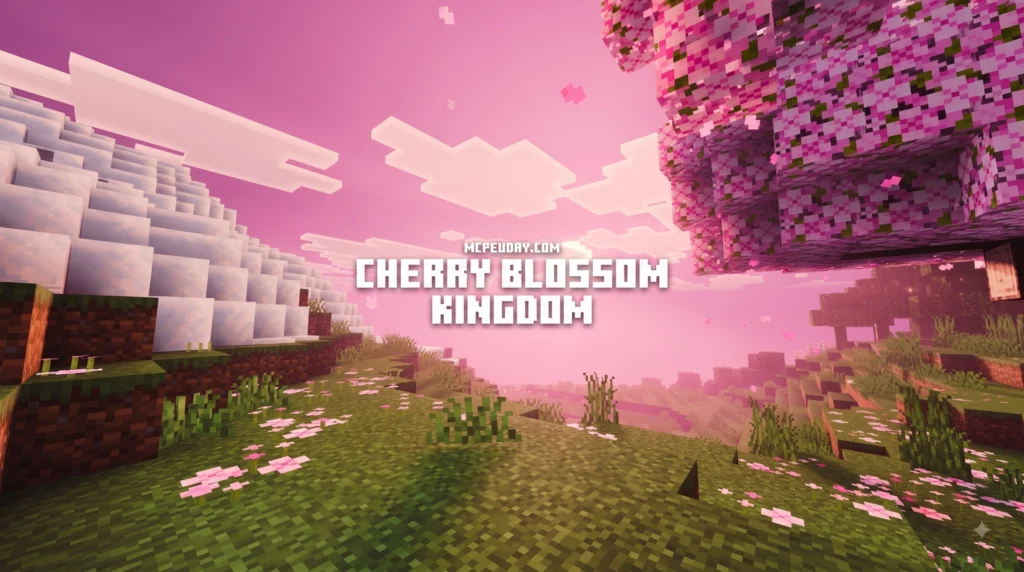
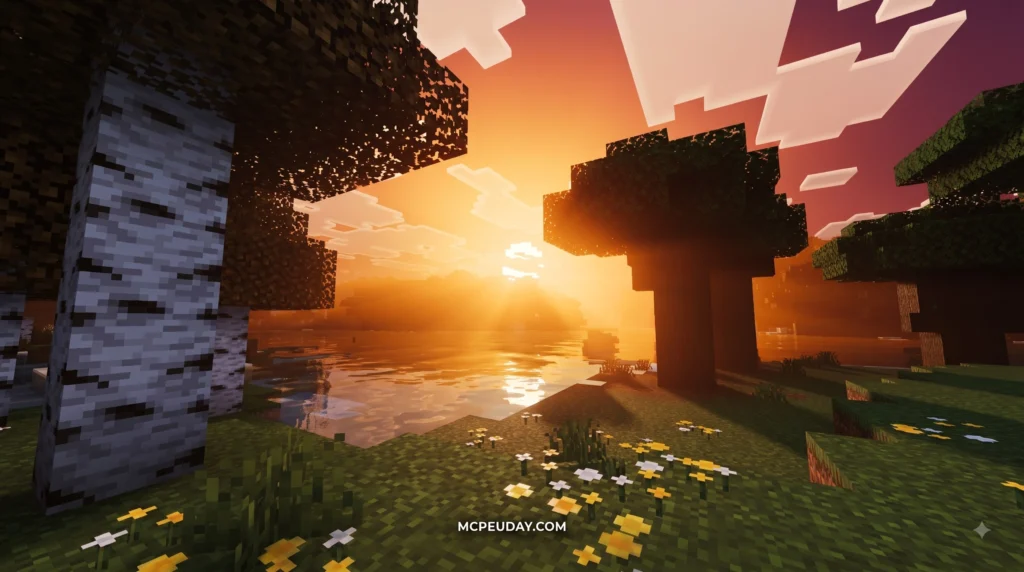
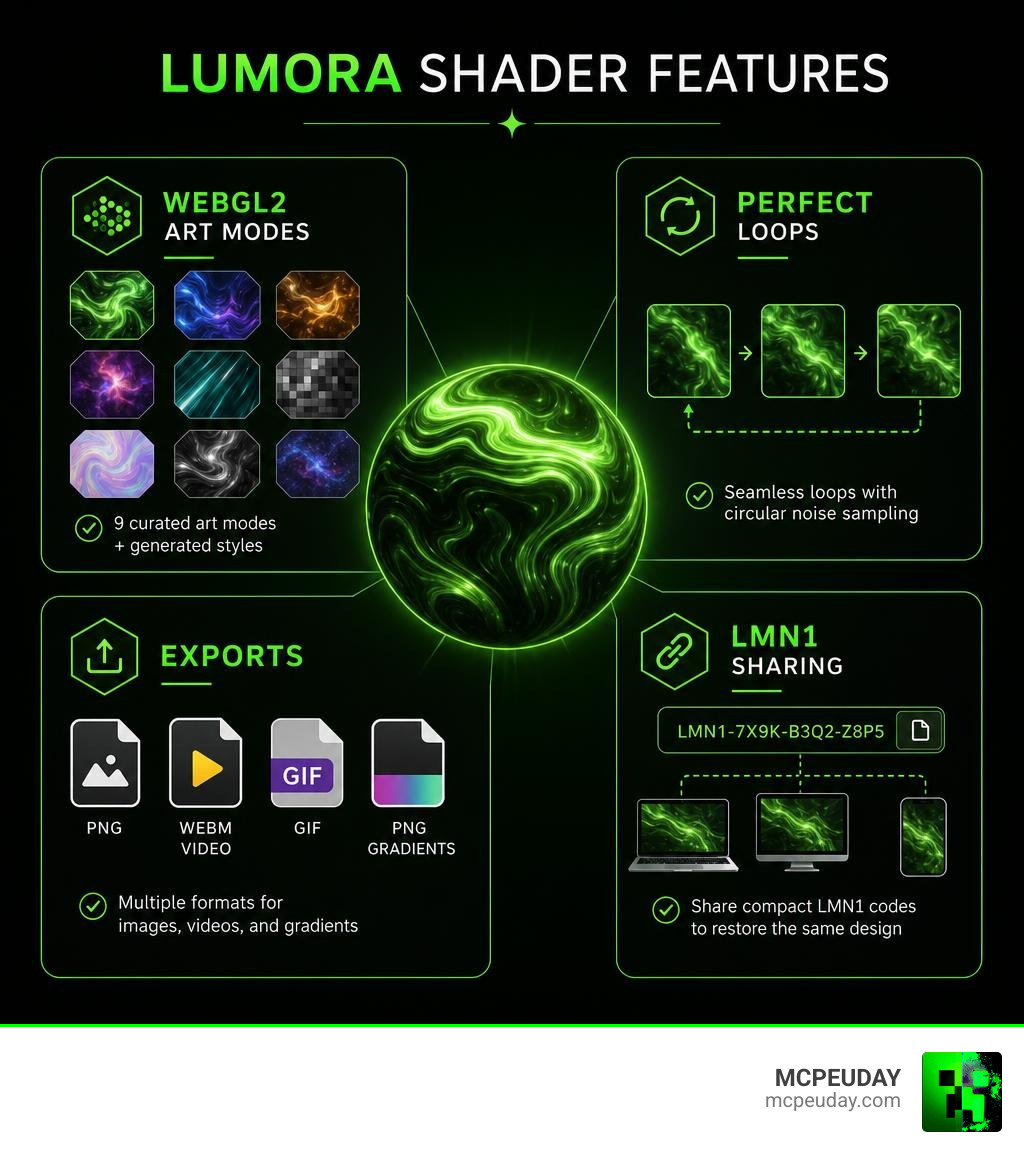
Lumora Shader is a browser-based generative art tool that uses WebGL2 to create animated abstract visuals, including liquid metal, light rays, soft blooms, pixel mosaics, and other shader-driven effects. It is not a Minecraft shader pack for Java, Bedrock, or MCPE. Instead, it runs in a modern web browser and turns adjustable visual settings into exportable images, GIFs, and looping videos.
| Quick fact | What it means |
|---|---|
| Rendering engine | Real-time WebGL2 graphics in the browser |
| Visual options | 9 curated art modes plus generated styles |
| Animation | Seamless loops built from circular noise sampling |
| Exports | PNG, WebM video, GIF, and PNG gradient sets |
| Sharing | Compact LMN1 codes can restore the same design |
For Minecraft players, the name can be confusing: Lumora focuses on abstract GPU art, not changing Minecraft water, shadows, mobs, or world lighting. Its value is in making backgrounds, profile visuals, stream assets, wallpapers, and short looping clips without a heavy desktop design app.
In this guide, I am UDAY GAMER, and I will break down how Lumora Shader works, what its controls do, and what to expect from its rendering and export tools.
Architecture and Engine Integration of Lumora Shader
Under the hood, Lumora Shader operates as a zero-dependency web application that renders procedural visuals in real time. Rather than relying on heavy desktop installation suites or complex build steps, it executes GLSL fragment shaders directly on the user’s graphics processor. By bundling modular shader structures, uniform stores, and render loop orchestrators, the engine transforms simple JavaScript properties into stunning high-frame-rate mathematical art.
To ensure high modularity, developers can utilize a ShaderModule | luma.gl structure to encapsulate reusable GLSL snippets, static uniform descriptors, and dynamic calculation logic across various render stages.
WebGL2 vs WebGPU Adapters in Lumora Shader
Although WebGL2 serves as the core rendering foundation for maximum current browser support, modern shader architectures are increasingly built with API agnosticism in mind. Modern graphics adapters maintain abstraction layers that allow uniform interfaces across WebGL2 context limitations and WebGPU backends.

While WebGL2 uses standard GLSL fragment structures with traditional coordinate bindings, WebGPU leverages WGSL with automated @binding annotations. By isolating render pipeline options from backend API calls, the underlying engine maintains high stability across diverse GPU hardware without requiring rewrite passes for different browsers.
Shader Modules, Uniform Types, and Dynamic Uniform Mapping
Managing real-time visual output requires linking JavaScript application state to GPU registers. Lumora accomplishes this using static default uniforms combined with dynamic calculation hooks.
Static property descriptors define primitive data types such as floats, integers, vector pairs, and matrices. During runtime, dynamic uniforms evaluate props such as elapsed frame time, resolution boundaries, and user controller settings. Advanced multi-stage post-processing pipelines can utilize tools like docs/api-reference/engine/passes/shader-pass-renderer.md to route dynamic texture targets, manage history buffers, and seamlessly blend pass inputs before presenting final frames to the display.
Generative Synthesis and Art Modes
The centerpiece of Lumora Shader is its flexible visual engine. Users can inspect source code structures on repositories like ausduns/lumenshaders to see how mathematical equations turn into animated patterns. The platform features 9 curated base art modes designed for instant visual feedback:
- Liquid Chrome: Metallic surface distortions with specular highlights.
- Silk Ribbons: Soft, flowing wave sheets with gradual color transitions.
- Soft Gradient Blooms: Gentle color blending built for wallpapers and UI headers.
- Aura Rings: Radiating circular energy waves with subtle edge dispersion.
- Light Rays: Directional beam projections that cut across moody backgrounds.
- Halftone Fields: Retro print-style dot grids that react to luminance values.
- Data Glyphs: Matrix-like digital characters and glowing code arrays.
- Reeded Glass: Vertical fluted glass refractions that warp underlying patterns.
- Pixel Mosaics: Retro blocky downsampling with adjustable grid resolution.
The 12-Gene Style Synthesizer Framework
Beyond the 9 standard modes, Lumora Shader includes a 12-gene style synthesizer capable of generating thousands of distinct visual outputs. The synthesizer decouples mathematical structures into discrete parameters:
- 6 Field Types: Noise vectors, voronoi cells, sine fields, fractal Brownian motion, gyroid fields, and distance fields.
- 5 Domain Geometries: Planar, radial, cylindrical, torus wrap, and mirrored symmetry.
- 4 Color Mappings: Linear gradients, cyclic spectrums, palette indexes, and luminance mapping.
- 4 Shading Models: Flat fill, diffuse Lambertian, specular Phong, and fresnel rims.
- 4 Overlays: Grain textures, scanlines, vignettes, and chromatic abberation.
| Feature Aspect | 9 Base Art Modes | 12-Gene Style Synthesizer |
|---|---|---|
| Preset Predictability | High, tuned hand-crafted visual targets | Unbounded procedural variation |
| Parameter Scope | Fixed mode controls | Multi-gene cross-blending |
| Geometry Control | Mode-locked field shapes | Dynamic domain swapping |
| Customization | Quick aesthetic selection | Deep exploratory generation |
Controller Parameters and LMN1 Code Serialization
Users do not need to write raw code to adjust visual patterns. The studio interface exposes interactive controllers organized across five main categories: color, form, lighting, texture, and motion. Users can modify custom palettes across 16 curated color sets or generate harmonic palettes using 4 editable focal colors plus custom background exposure.
Every visual design created in Lumora Shader serializes into a compact string starting with the prefix LMN1. This compact serialization packs color selections, gene parameters, lighting positions, and speed multipliers into an easily copyable code. Embedding this code directly into web URLs allows exact state restoration without needing external database storage.
Mathematical Loop Construction, Lighting Models, and Audiovisual Sync
Creating repeating background animations can be difficult, as traditional linear timers create noticeable jump cuts when they reset. Lumora Shader solves this issue by using mathematically perfect animation loops.
Seamless Loop Generation with Closed Circle Noise Sampling
Instead of sampling a procedural noise field along a standard linear time axis, the engine samples noise coordinates along a closed circle within a multi-dimensional space.
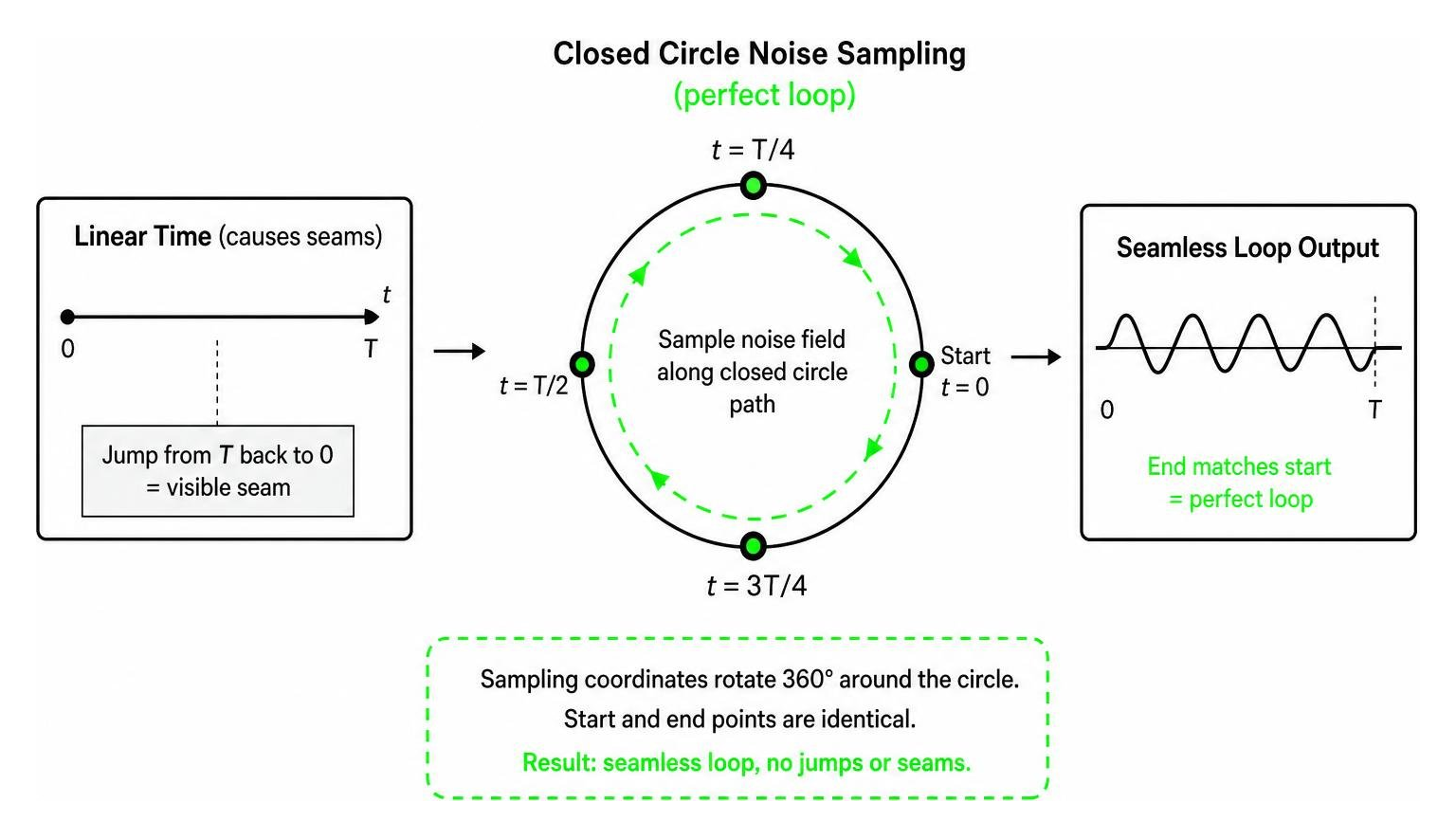
As time advances, the sampling position completes a 360-degree rotation around the circle’s radius. Because the start and end points of a closed circle are physically identical, the generated animation seamlessly loops forever without jarring frame jumps or visible seam lines.
Lighting Prop Types and Audiovisual Hook Injections in Lumora Shader
Lighting plays a critical role in bringing procedural surfaces to life. The engine incorporates dynamic lighting parameters similar to standard graphics frameworks outlined in lighting | luma.gl.
- Ambient Light: Supplies baseline color fill across the entire canvas.
- Point Light: Emits localized illumination that falls off with distance.
- Spot Light: Projects focused light cones with adjustable inner and outer angles.
- Directional Light: Simulates distant sunlight with uniform parallel light vectors.
Additionally, built-in sound stage injections connect visual parameters directly to live audio frequencies. Bass beats can modulate point light intensity, while higher frequencies trigger chromatic aberration or scale noise fields, creating real-time visual reactions to music tracks.
Offline Rendering Pipelines and Export Capabilities
Exporting real-time browser graphics can sometimes result in dropped frames or slow encoding times. Lumora Shader uses offline canvas rendering processes to ensure crisp, full-frame-rate exports regardless of display refresh rates.
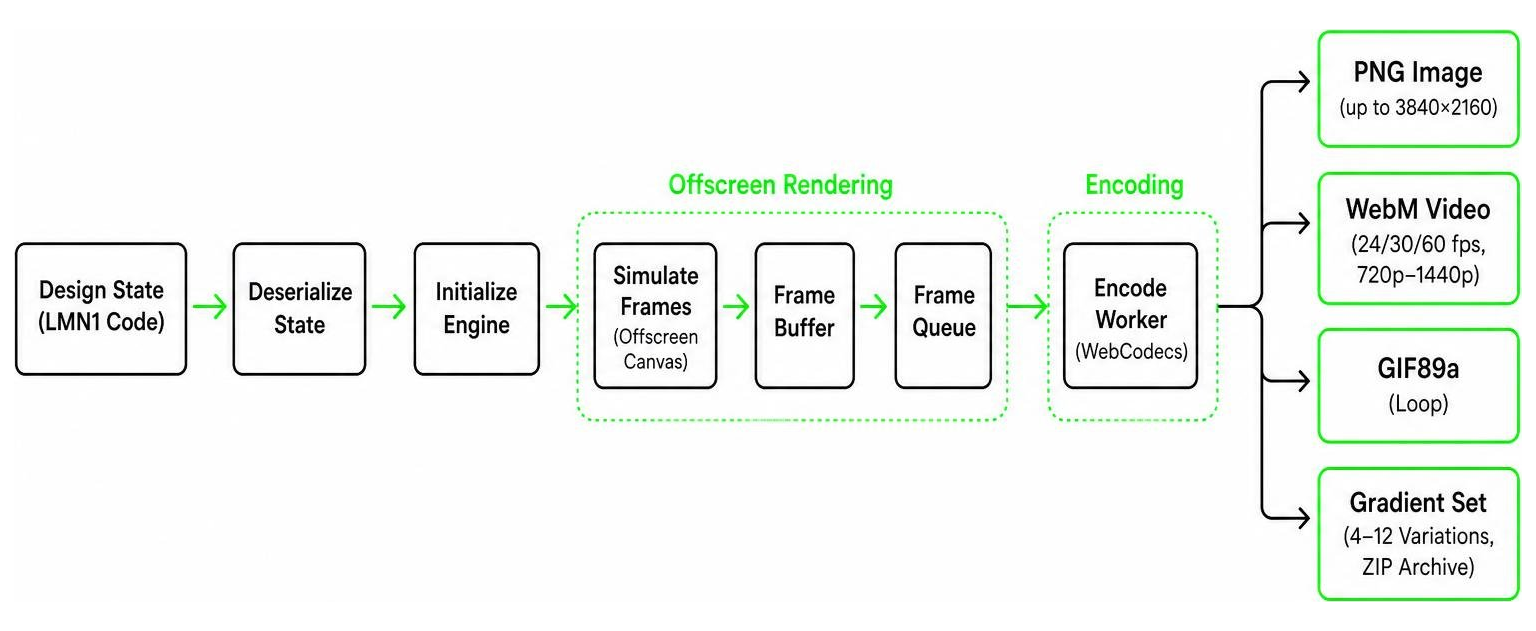
- PNG Images: Single frame snapshots rendered up to 3840×2160 resolution.
- WebM Videos: Smooth motion clips encoded via WebCodecs at 24, 30, or 60 fps (720p to 1440p).
- GIF89a Animations: Compact loops using median-cut palette quantizers and ordered dithering.
- Gradient Sets: Batch export packages containing 4 to 12 design variations compiled into a ZIP archive.
High-Resolution PNG Pipeline and Gradient Export Sets
When a static render command is triggered, the studio creates an offscreen canvas decoupled from the visible viewport dimensions. It applies user settings at crisp resolutions up to 3840×2160 (4K).
For designers seeking cohesive color variations, the gradient set feature generates 4 to 12 distinct variations of the active design seed. The engine renders each item offscreen and compresses the entire collection into a downloadable ZIP file containing pristine PNG assets.
Dependency-Free WebM and GIF Encoders
To export video without third-party server processing, Lumora Shader utilizes native WebCodecs (VideoEncoder) paired with a lightweight, dependency-free WebM container writer. Frame rendering runs frame-by-frame offscreen, ensuring zero dropped frames regardless of computer performance.
For lightweight GIF animation exports, the studio relies on a custom GIF89a encoder. The pipeline uses median-cut color quantization to calculate ideal 256-color palettes, followed by ordered dithering to prevent color banding while keeping file sizes small.
Frequently Asked Questions about Lumora Shader
How does Lumora Shader achieve mathematically seamless looping?
The engine samples multi-dimensional noise fields along a closed circular path rather than a straight line. Rotating 360 degrees around this circular path brings the sampling position back to its exact origin point, creating an endless, seamless loop.
What export formats and resolutions does Lumora Shader support?
It supports high-resolution PNG image exports up to 3840×2160, WebM video loops at configurable frame rates (24, 30, or 60 fps) from 720p to 1440p, custom GIF89a animations, and batch PNG gradient sets downloaded as ZIP files.
How does LMN1 serialization preserve exact design parameters?
LMN1 codes serialize all active UI states—including synthesizer gene configurations, color hex values, light positions, and noise speeds—into an encoded text string. Re-entering this string decodes the exact parameters back into the engine state.
Conclusion
At MCPEUDAY, our mission is to explore cutting-edge graphics tech, modding resources, and visual tools. While Lumora Shader is a standalone WebGL2 web application designed for browser art generation rather than a Minecraft world pack, its approach to modular shaders, WebCodecs exporting, and procedural math offers great insights for digital artists and world creators alike.
If you are looking to revamp your actual Minecraft game worlds with stunning dynamic lighting and enhanced visual effects, Explore top realistic Minecraft shaders in our curated gaming collections!