What Is a BuildCraft Addon? (Quick Answer)

A BuildCraft addon is a mod that extends or enhances the core BuildCraft mod for Minecraft Java Edition. These addons add new pipes, machines, power systems, and automation tools that go beyond what BuildCraft includes by default.
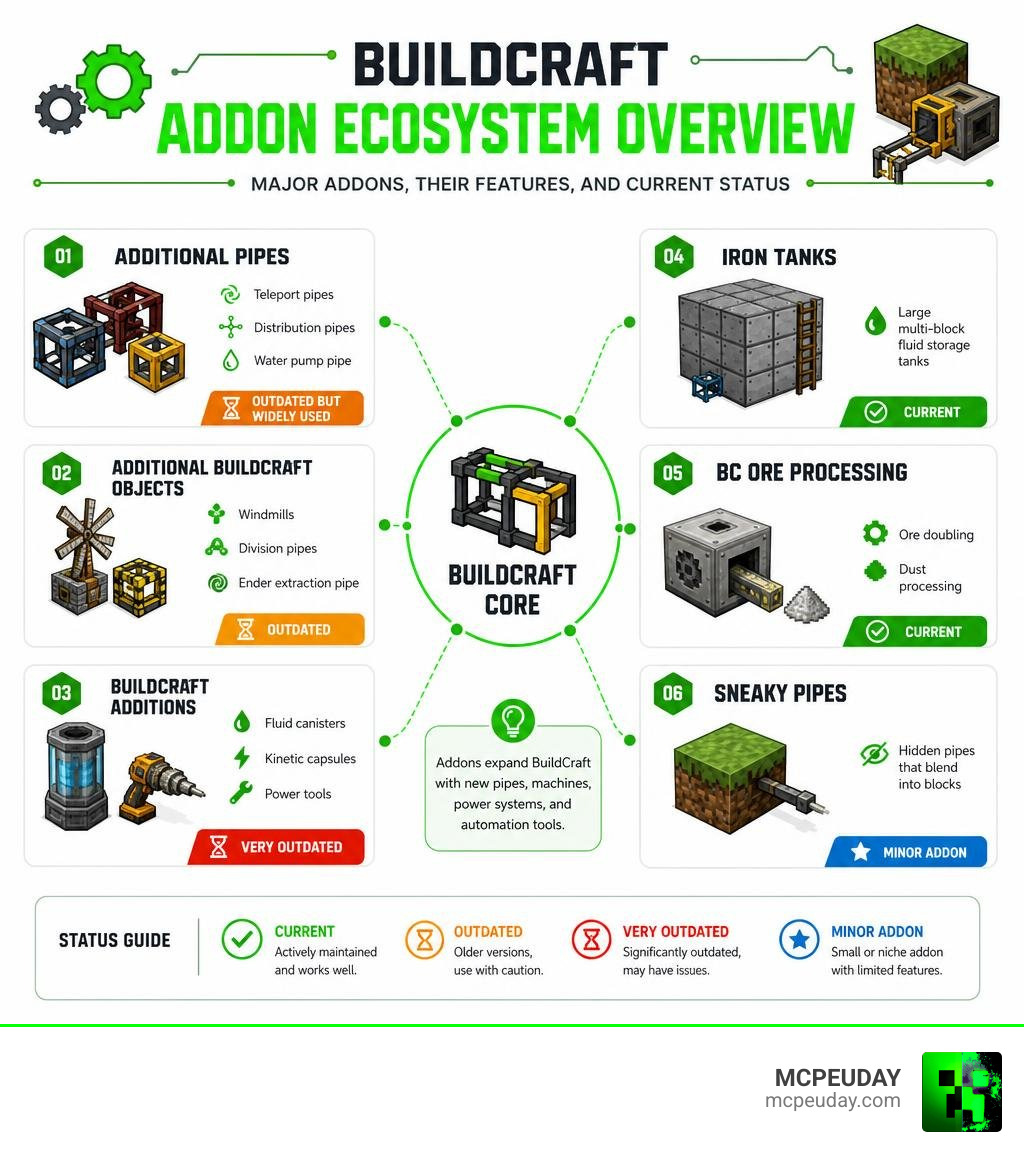
Here are the most popular BuildCraft addons at a glance:
| Addon | What It Adds | Status in 2026 |
|---|---|---|
| Additional Pipes | Teleport pipes, distribution pipes, water pump pipe | Outdated but widely used |
| Additional Buildcraft Objects | Windmills, division pipes, ender extraction pipe | Outdated |
| BuildCraft Additions | Fluid canisters, kinetic capsules, power tools | Very outdated |
| Iron Tanks | Large multi-block fluid storage tanks | Current |
| BC Ore Processing | Ore doubling and dust processing | Current |
| Sneaky Pipes | Hidden pipes that blend into blocks | Minor addon |
BuildCraft itself is one of Minecraft’s oldest and most influential mods, with over 1,361 stars on GitHub and a modding legacy stretching back to 2012. Its open API made it easy for other developers to build on top of it — and that’s exactly where addons come in.
Whether you want to teleport items across dimensions, generate power from windmills, or process ores into dusts, there’s an addon for it. The challenge is knowing which ones still work, which are abandoned, and how to combine them without breaking your modpack.
This guide covers everything — from the biggest complementary mods like Thermal Expansion and Forestry, to smaller standalone addons that add just one or two new pipes.
What is a BuildCraft Addon and How Does It Work?
A BuildCraft addon functions by hooking directly into the core BuildCraft API. Because BuildCraft was designed with an open architecture, it allows third-party developers to register custom pipes, triggers, actions, and machine recipes.
In the early days of modding, BuildCraft used its own power standard called Minecraft Joules (MJ). Over the years, the ecosystem shifted toward Redstone Flux (RF). Addons bridge these power systems, allowing players to run BuildCraft quarries and lasers using energy generated by other mods. By tapping into BuildCraft’s pipe network, addons can change how items, fluids, and energy move through your world. For a complete historical list of these tools, you can explore the Addons | Minecraft buildcraft Wiki | Fandom page.

Choosing the Right BuildCraft Addon for Your Modpack
When building a custom modpack, choosing the right BuildCraft addon requires careful attention to Minecraft versions and API compatibility. BuildCraft went through a massive rewrite starting with version 8.0 (targeting Minecraft 1.12.2), which broke compatibility with older addons.
If you are playing on classic legacy versions like 1.7.10, you will have access to almost every addon ever made. For newer setups, you will need to look for modern forks that support the updated Forge API. While modern Bedrock players often look for a Create Addon to handle their mechanical needs, Java players still rely on these classic BuildCraft frameworks to build complex automation pipelines.
How to Install a BuildCraft Addon Safely
Installing these addons follows the standard Minecraft Forge procedure, but because they depend heavily on the core BuildCraft mod, loading order is crucial. We always recommend backing up your worlds before adding or removing any mods.
- Ensure you have the correct version of Minecraft Forge installed.
- Download the main BuildCraft mod and place it into your
modsfolder. - Download your chosen BuildCraft addon and place it in the same folder.
- Launch the game and check the mods menu to ensure both are loaded.
Just as you would set up an Effortless Building Addon to streamline your construction projects, setting up your automation mods correctly from the start saves hours of troubleshooting down the road.
Major Complementary Mods and Synergies
While standalone addons introduce specific blocks, major complementary mods reshape how we use BuildCraft entirely. These large-scale mods integrate so seamlessly that they are often considered essential partners.
| Complementary Mod | Primary Synergy with BuildCraft | Key Benefit |
|---|---|---|
| Forestry | Combines automatic farms with BuildCraft pipes | Automated fuel and crop production |
| RailCraft | Integrates steam boilers and cart loaders | Advanced long-distance logistics |
| IndustrialCraft 2 | Power conversion and high-tier machines | Converts EU power to run BuildCraft quarries |
| Thermal Expansion | Native RF power compatibility | Flexible, high-speed fluid and item transport |
| MineFactory Reloaded | Automated farming and ranching | Generates raw materials for pipe sorting networks |
Forestry and RailCraft Integration
Forestry was originally developed as a direct addon for BuildCraft to automate farming. It introduces multi-block farms that produce wood, wheat, and bio-liquids. These liquids can be pumped directly into BuildCraft combustion engines to generate massive amounts of power.
RailCraft takes this a step further by introducing steam-based power systems and advanced minecart loaders. By combining RailCraft’s steam boilers with BuildCraft’s fluid pipes, we can build massive power plants that distribute energy across our entire base.
IndustrialCraft and Thermal Expansion Power Systems
Managing energy is the biggest challenge in tech-based modpacks. IndustrialCraft 2 uses Energy Units (EU), while Thermal Expansion uses Redstone Flux (RF).
BuildCraft’s kinesis pipes act as the perfect middleman. With the right addons, players can convert EU from IndustrialCraft nuclear reactors into RF or MJ, driving BuildCraft’s high-speed quarries and assembly tables without needing separate power grids.
Notable Standalone Addons and Unique Mechanics
Beyond the massive tech mods, several smaller, dedicated addons introduce specialized pipes and tools that solve very specific automation problems.
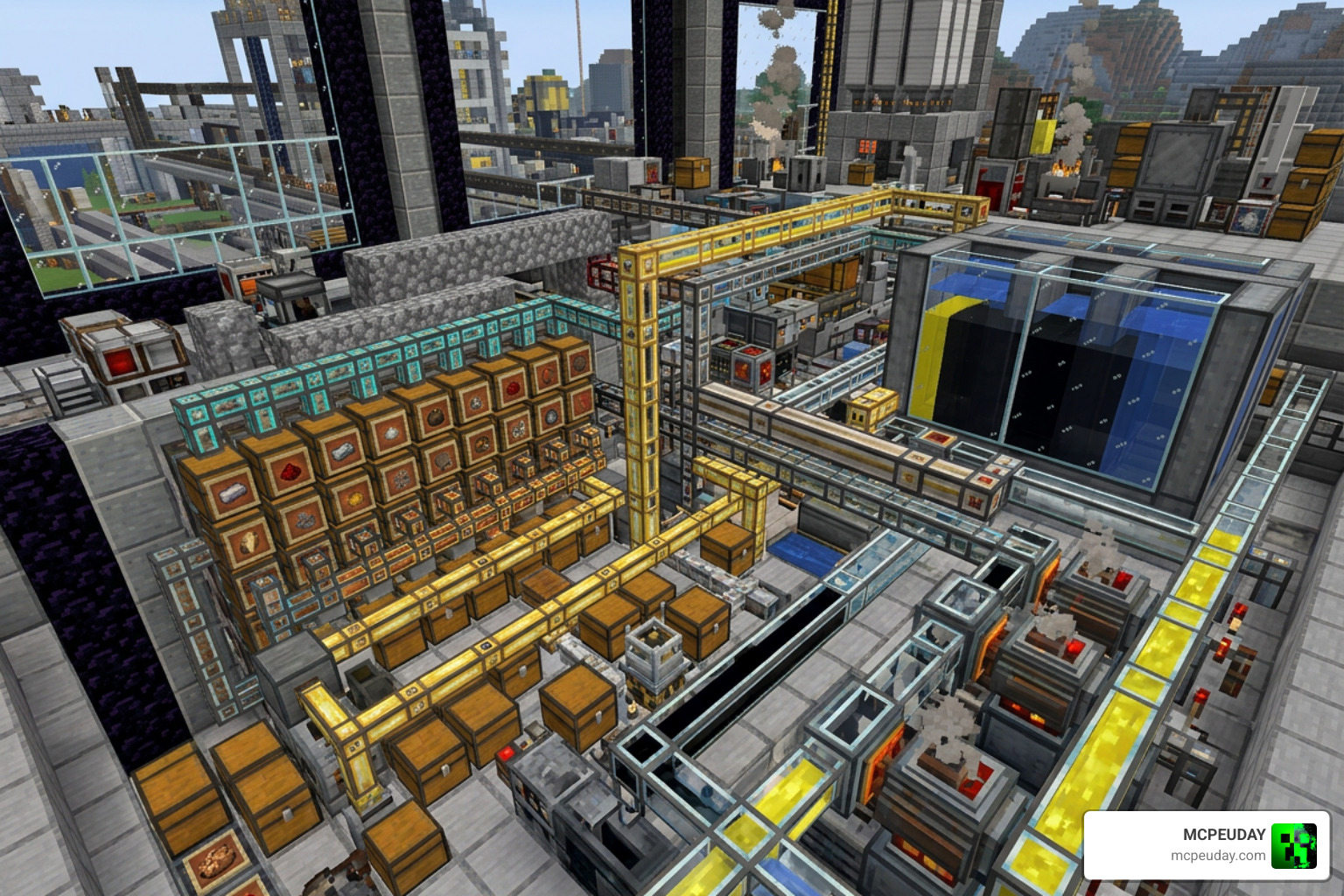
Additional Pipes for BuildCraft
With over 662,579 downloads on CurseForge, Additional Pipes for Buildcraft is one of the most popular addons in Minecraft history. Developed and maintained over the years by creators like Zeldo, tcooc, and MultipleMonomials, this mod solves the hassle of long-distance pipe networks.
Its standout features include:
- Teleport Pipes: These allow players to wireless transport items, fluids, and power across dimensions. The Power Teleport Pipe can transfer up to 2560 RF/t with a small default energy loss of 10%.
- Water Pump Pipe: Automatically pumps water from source blocks below it at a default rate of 90MB per tick, eliminating the need for complex redstone engine setups.
- Distribution Pipe: Allows players to set exact item ratios (e.g., sending 2 seeds to a farm and 1 to storage).
- Closed Pipe: Acts as a buffer, holding items safely inside instead of letting them spill onto the ground when a chest is full.
You can view the source code and development history on the tcooc/AdditionalPipesBC repository.
BuildCraft Additions and ABO
Another legendary addition is Additional Buildcraft Objects (ABO), which you can find on the da3dsoul/Additional-Buildcraft-Objects repository. ABO introduces unique transport mechanics like the Division Pipe (which splits item stacks into smaller sizes using a wrench) and the Ender Extraction Pipe (which extracts items directly from ender chests across dimensions). It also introduces windmills that generate up to 15 RF/t depending on the height, biome, and weather.
For those looking to expand their item processing, BCA-Team/Buildcraft-Additions adds fluid canisters, kinetic capsules, and power tools. If you look at the BuildcraftAdditions.java example, you can see how the mod registers custom metal and gem dusts to support a robust ore-doubling system directly integrated with BuildCraft’s refinery.
Advanced Automation and Example Use Cases
To see the true power of a BuildCraft addon, let’s look at how we can combine these mods for high-level automation.
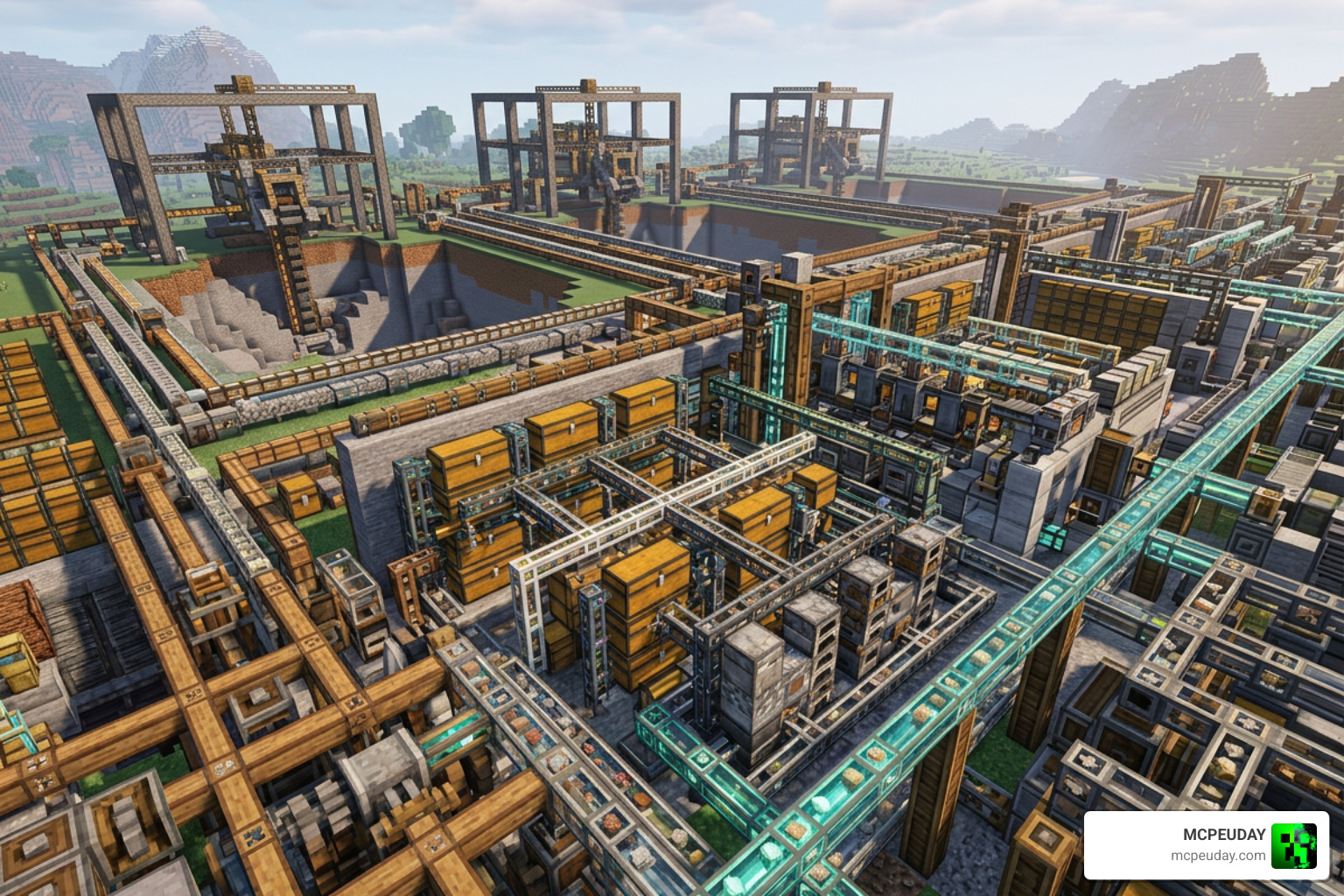
One classic setup is the Self-Sustaining Biofuel Loop. By using Forestry multi-block farms to grow crops, we can pipe the harvest into a processing machine like “The Vat” (from the Better Then BuildCraft series).
Using the Vat, we can combine 1 Potash, 8 Sugar, and 64 crops (like wheat or hemp seeds) to produce biofuel. This biofuel is then pumped via Waterproof Intake Valves into BuildCraft combustion engines. These engines power the farms and the Vat itself, creating a closed-loop system that generates excess power and resources automatically.
Frequently Asked Questions about BuildCraft Addons
Are BuildCraft addons compatible with modern Minecraft versions in 2026?
Most classic BuildCraft addons are designed for legacy versions like 1.7.10 and 1.12.2. While BuildCraft remains highly popular on these legacy versions, community developers in 2026 are actively working on modern ports and unofficial updates for newer Minecraft versions.
What is the difference between MJ and RF power in BuildCraft?
MJ (Minecraft Joules) is BuildCraft’s original native power system. RF (Redstone Flux) is a universal power standard used by many other tech mods. Modern versions of BuildCraft and its addons use RF (or FE/Forge Energy) to make power distribution across different mods seamless.
Can I use BuildCraft addons on Bedrock Edition?
BuildCraft and its primary addons are Java Edition mods. However, Bedrock players can find similar automation experiences by looking for Bedrock-compatible alternatives, such as the Create Bedrock Addon on our platform.
Conclusion
BuildCraft addons remain a cornerstone of Minecraft’s technical modding history. From wireless teleport pipes to advanced multi-block tanks, these community-created expansions turn simple pipe networks into massive, automated industrial empires.
At MCPEUDAY, we love celebrating the mods that shaped how we play Minecraft. Whether you are building a legacy Java tech pack or looking to Explore more Minecraft Bedrock Addons for your mobile world, we have the resources, guides, and downloads you need to start building.
Download
Download Addon
MORE ADDONS – MCPE/Bedrock – MCPEUDAY
Free with Minecraft Marketplace All Packs – Click and Join